Background
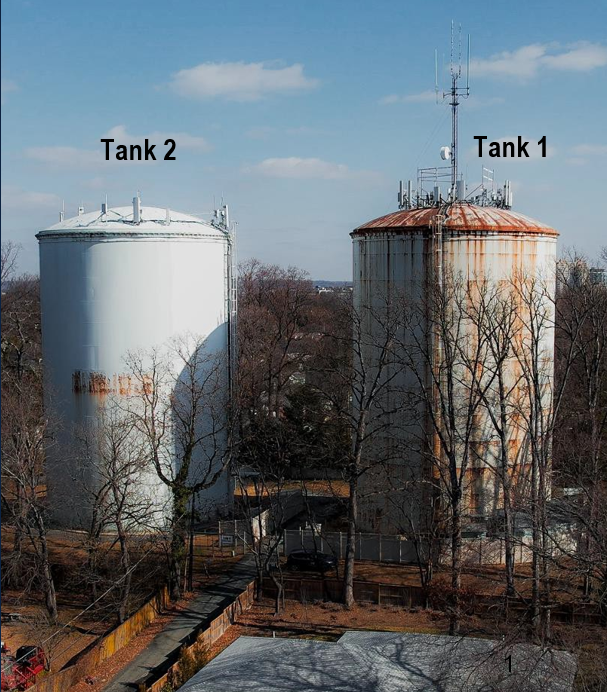
The Bradley Hills Standpipes 1 and 2 are located at 7005 Radnor Rd. Bethesda, Maryland. Tank 1 was constructed in 1939 with a storage capacity of 2.5 million gallons, and Tank 2 was added in 1961, increasing the storage capacity to 2.6 million gallons to meet increasing water demand. The standpipes at approximately 110-ft tall and 70-ft in diameter.
The purpose of the project is to repair and upgrade the existing tanks, including structural improvements, safety upgrades, and new protective coatings, to extend their service life and ensure reliable water storage and support for the community.
Project Scope
Site Work
Site work will include installing new yard piping, altitude valve vault, replacing broken or inoperable valves, repaving the access drive, and site grading to improve drainage. The project will also include landscaping and final site restoration to stabilize the area and restore the site once construction activities are complete.
Structural
Tank 1 requires the roof to be replaced. The existing roof will be removed and a new roof in the same style will be installed. Tank 2 roof requires only repairs/replacement of roof rafters. Both tanks will have the existing platforms, and ladders removed and replaced with new OSHA-compliant railings, manways, and ladders.
These improvements will extend the service life of both tanks and enhance overall system performance. As well as make the site safer for WSSC Water employees to maintain and work on both standpipes.
[Image]
Tank Coating
Both tanks will receive a new epoxy-based coating for the interior and exterior of the tank that has a service life of approximately 20-30 years. The interior coating will be NSF-certified for potable water. The existing coatings will be abrasive blasted from the tank to prepare the steel for the new coatings.
Containment System
A Class 2-A containment system will be installed around the existing tank structure to control debris and emissions during surface preparation and coating operations. The system will contain particles generated during the removal of the existing coating and prevent paint overspray during the application of new coatings. All waste materials will be handled and disposed of in accordance with Occupational Safety and Health Administration (OSHA), Environmental Protection Agency (EPA), and other applicable environmental and safety regulations.
During construction, an independent industrial hygiene team will conduct air and soil monitoring to ensure dust, debris, and lead particles remain contained.
Air samples will be collected around the work area to verify that lead levels remain within safe limits, and soil testing will confirm that no contamination occurs. All monitoring and testing will be performed by EPA-accredited laboratories to ensure compliance with environmental regulations and project safety requirements.
Community Impact
There may be minor traffic impacts due to construction vehicles and material deliveries to the site. To reduce disruptions, deliveries will not occur between 8:15–10:00 a.m. and 2:30–4:00 p.m. to avoid school bus pick-up and drop-off times.
Community members should expect these construction activities to generate noise from the equipment and abrasive blasting. During this work, the contractor will adhere to the required noise suppression plan with the goal of minimizing loud noise, to the extent possible. The contractor will follow county noise ordinance requirements.
Erosion control measures will be in place to protect the surrounding area, which includes silt fence and stabilized construction entrance.
Construction hours have not been determined but the contractor is expected to work an 8-hour workday Monday through Friday. The contractor may request to work overtime which would include weekends. Residents will be provided at least (72 hours) notice prior to any weekend work. The contractor will follow county noise ordinance requirements.
There are no anticipated water service interruptions for residents as part of this project.
Estimated Construction Schedule
Phase 1 – Summer 2026 – Winter 2026 (weather permitting)
- Tree removal
- Temporary construction fencing installation
- Communications buildings relocation
- Temporary communications tower construction
- Communications antenna relocation
Phase 2 – Winter 2026 – Fall 2028 (weather permitting)
- Construction start outreach meeting
- Site preparation
- Tank rehabilitation
- Tank painting/abrasive blasting
- Driveway repaving and fence installation
- Site landscaping
Additional Information
Community Questions and Responses
- June 3, 2026, Community Meeting Presentation (PDF 5.85 MB)
- Location map (PNG 433 KB)
- Project history (PNG 205 KB)
Contact
Christopher DeHerde, WSSC Water Project Manager
- Telephone: 301-206-8560
- Email: [email protected]
Last Modified: June 5, 2026, 11:32 am EDT