Greenbelt Standpipe Rehabilitation Project Summary of Air and Soil Monitoring Results
Independent testing shows lead levels well below U.S. Environmental Protection Agency health-based standard
Independent testing shows lead levels well below U.S. Environmental Protection Agency health-based standard
Recent independent air monitoring conducted during paint removal activities at the Greenbelt Standpipe Tank Rehabilitation Project found lead levels approximately 15 times lower than EPA health-based standard for outdoor air. These independent results show project dust controls are working as intended and that measured lead levels are well below the limit set to protect public health.
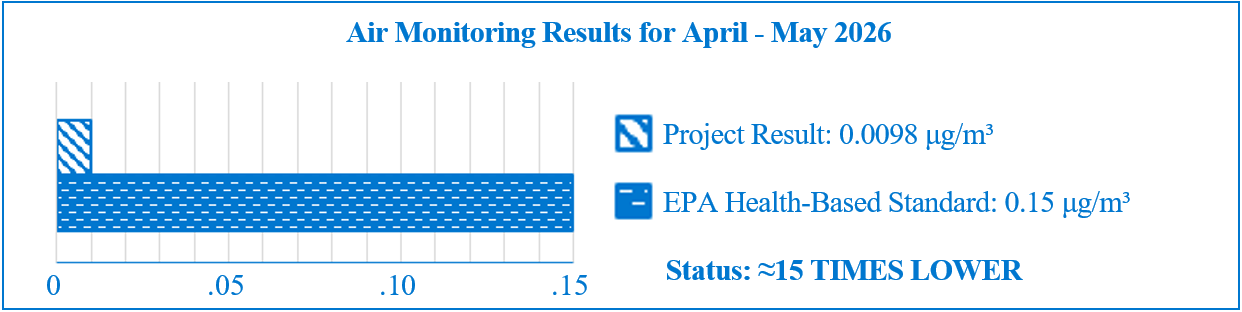
Air monitoring during paint removal/abrasive blasting in April - May 2026 showed that lead levels were well below the EPA's health-based standard for outdoor air. Independent consultants did the testing, and the results show that containment measures are working.
Before blasting began, air quality was measured to establish a baseline. Results during blasting are compared to the original conditions. While this monitoring does not constitute an official EPA compliance check, it is a commonly used method for carefully monitoring airborne dust and ensuring containment measures are working properly during construction activities.
Abrasive blasting is the project activity most likely to affect air quality. That’s why the air is monitored in 8-hour periods when airborne dust is expected to be highest. These tests also check how well our dust containment measures are working. The results are then compared to the EPA health-based standard.
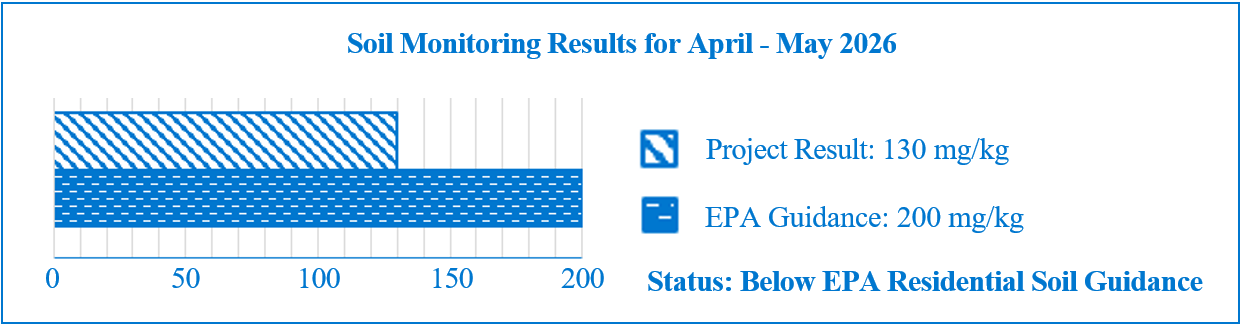
Soil and Land Use Technology, Inc. (SaLUT), an environmental consulting company, is handling air and soil monitoring and analysis for the Greenbelt Standpipe Tank Rehabilitation Project. Their lab measures lead in Total Suspended Particles (TSP), a standard method for assessing airborne dust. Soil samples are also collected and analyzed to determine the amount of lead present. Results are reported in milligrams per kilogram (mg/kg), which measures the amount of lead contained in the soil. The results here are based on samples SaLUT collected during blasting in April - May 2026.