


Applicability
This announcement supersedes all previous announcements regarding masonry chimney restrictions and is effective July 1, 2015 and beyond.
Authority
WSSC is the jurisdictional code authority for natural gas and propane appliance installations in Prince George’s and Montgomery Counties with the exception of the Cities of Rockville and Poolesville. Note: the King Farm section of Rockville is under WSSC regulatory jurisdiction. This regulatory authority is not limited to WSSC Customers (those served by WSSC’s water or sewer services), but also governs residents served by private wells and/or septic systems and City of Bowie customers as well.
Scope
WSSC is providing notice of very important installation restrictions for residential gas customers whose gas appliances vent into an interior or exterior masonry chimney.
Background
These venting restrictions are a sign of the changing times and were brought about by changes in federally mandated operating efficiencies for gas appliances, which in turn, drove improvements to the International Fuel Gas Code (IFGC). The IFGC is the adopted technical guidelines that WSSC uses in concert with the WSSC Plumbing and Fuel Gas Code. The IFGC has published a number of newer and revised code sections and related sizing tables to account for changes to gas equipment efficiencies. These improved efficiencies have a direct impact on the venting/exhaust characteristics of gas appliances. Primarily, these restrictions will affect the installation and/or replacement of residential type gas furnaces, boilers, and water heaters.
In addition, on April 15, 2015 the U.S. Department of Energy (DOE) enacted even stricter energy guidelines for water heaters listed for residential use. Beginning in April, all residential type water heaters manufactured and sold will have increased energy efficiency ratings, to as much as 80%. Furnace and boilers were required to have higher (80 %+) efficiencies beginning in the early 1990’s.
Appliance Terms:
- Low-efficient Space Heating Appliance. A warm air furnace or boiler with an energy efficiency rating below 80%. These dinosaurs were factory equipped with a draft hood and due to energy codes they have been marketplace-obsolete since the early 90’s. National energy standards do not allow them to be sold any longer.
- Mid-efficient Space Heating Appliance. A warm air furnace or boiler with an energy efficiency rating between 80-89%. Very common for this area; typically uses a vertical main vent (either masonry or round metal “B-vent”).
- High-efficient Space Heating Appliance. A warm air furnace or boiler with an energy efficiency rating of 90% or greater. Typically uses a plastic vent system (1 or 2 pipes) and is not interconnected with other appliances or connected into a chimney; it vents independently and directly outdoors.
- Draft Hooded Water Heater (low efficiency). Constructed to pre-April 2015 requirements - was the most common variety of gas water heater. Okay for sale and install until supply depletes.
- Mid-efficient Water Heater. Meets April 2015 energy standards. May possess a fan-assist, damper, or draft hood; or combinations of two. Must be treated same as a mid-efficient space heating appliance.
- High-efficient Water Heater. Like its space heating counter parts, typically uses a plastic vent system (1 or 2 pipes) and is not interconnected with other appliances or connected into a chimney; it vents independently and directly outdoors.
Technical Justifications
As gas appliance energy efficiency has increased, the appliance’s corresponding vent/flue/exhaust temperatures have been lowered. With lower vent/flue/exhaust temperatures, there is an increased probability of the vent/flue/exhaust gases/vapors (the by-products of combustion) turning to liquid form before they can vent out (travel up and out), the top of the chimney. Nowhere is this more likely than with a masonry chimney. Masonry chimneys by their nature require significantly higher temperatures, and for greater duration, in order to “warm” the mass that is the chimney structure. See the illustration below. Add exposure to cold temperature influences and it is a losing battle for the vent/flue/exhaust gases/vapors. As the gases/vapors liquefy, the resulting condensate water (which is acidic), will cover/coat the inside clay liner of the chimney. Over time, the condensate can be responsible for the degradation of the interior lining of the chimney and in some cases, negatively impact the gas appliance(s) and the vent connector piping which connects each appliance to the chimney. In the long run, the chimney passageway can become blocked, the connector piping and chimney can deteriorate to the point of collapse, or the appliance itself can deteriorate. With any of these failing scenarios, vent/flue/exhaust gases are going to be expelled into the living quarters which significantly increases the chance of dangerous Carbon Monoxide (CO) gas being produced; which will also be expelled into the living quarters. It is that serious.
Another issue related to cold chimneys is the potential for “damming” of the natural flow of the flue gases/vapors. In this case, the entire venting dynamic is slowed which effects the amount of extra air entering the chimney for drying purposes and it can also lead to imperfect combustion. The latter has an adverse effect on overall efficiency and it can cause production of excessive carbon monoxide (CO) which is a great concern with any slow vent or if vent spillage occurs.
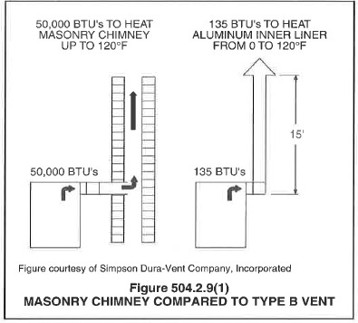 Figure 504.2.9(1) has been copied from the 2012 International Fuel Gas Code and Commentary. It explains why masonry chimneys are so hard to “warmup” and also how difficult they are to keep warmed.
The Restriction
In most applications where space heating appliance(s) [furnaces and boilers] are served by a masonry chimney, the chimney will require the installation of a listed liner when any of the existing appliances served by the chimney are replaced. According to the sizing charts contained in the 2015 International Fuel Gas Code (IFGC), outside chimneys cannot be utilized “as is” unless a minimum of 300,000 – 400,000 Btu’s are connected. Given that most residential applications of space heating appliances and water heaters are limited to about 175,000 Btu’s or less, outside chimneys are virtually eliminated as an approvable application from this point forward.
WSSC, with the support of Washington Gas, has proactively taken steps to address the 2015 changes to water heater energy efficiencies:
- First amendment, the Exception under IFGC Section 503.5.6.1 was removed by amendment to the Code; there are no possible scenarios where a new appliance can be recognized as a “like-for-like” replacement of an existing appliance.
- Second amendment: interior masonry chimneys will be treated as exterior for purposes of applying the appropriate sizing Table(s); in this cold climate many interior chimneys are exposed to extreme cold temperature in un-heated, un-insulated attics.
- Third amendment: recognize that masonry chimney restrictions should not be limited to only space heating appliances, now that residential water heaters must also be, at minimum, midefficient.
- Result: WSSC will only use “Exterior” Masonry Chimney Tables and recognize that “minimum input” restrictions apply to water heaters (listed April 2015 and beyond), as well as space heating appliances.
What should I (a homeowner or occupant), expect if I need to have a gas appliance(s) replaced and the appliance is venting to a masonry chimney?
Refer to the table on the following page for the specific scenarios and follow the requirements outlined in the last column.
Consult with a plumbing or HVAC firm who is represented by a WSSC licensed Master Plumber/Gasfitter; their WSSC license number in required to be displayed in any form of advertisement, including the internet; their staff will be able explain the various scenarios and the variety of actions/options available.
In addition, the installing plumber/gasfitter shall also be referring to the International Fuel Gas Code and the WSSC Plumbing and Fuel Gas Code for more details.
What if I decide to proactively reline my chimney and I am not replacing any appliances at this time?
The installation of a chimney liner is part of the regulated gas venting system. This work shall be represented by a WSSC licensed Master Plumber/Gasfitter. Any independently operating company, specializing in chimney cleaning and lining, shall be represented by a WSSC licensee. A short form permit and approved inspection is required.
Masonry Chimney Venting - Required Action regarding Water Heaters and Space Heating Appliances
| Scenarios | Water Heater Status and Efficiency | Space Heating Appliance Status and Efficiency | Venting Requirements and Comments |
| 1 | Existing (to Remain) Any efficiency | Existing (to Remain) Any efficiency | There is no requirement to upgrade a chimney/vent unless one or more appliances are replaced or removed from the current venting configuration. However, heed the installation/operation instructions for your current appliance(s): have the chimney, the appliance(s), and the vent connector piping inspected annually; and clean, repair or abate as needed |
| 2 | New or Replacement Low Efficiency or Mid Efficiency | Existing (to Remain) High Efficiency | A new water heater can no longer vent into a clay lined masonry chimney. Chimney shall be relined with a listed liner meeting UL 1777 or with a “B-Vent” or both appliances can be replaced with High-efficient appliances and the chimney inlet(s) capped. |
| 3 | New or Replacement High Efficiency (replacing draft hooded WH) | Existing (to Remain) High Efficiency | Install new water heater vent directly to outdoors per manufacturer’s instructions, coordinate with space heating appliance venting instructions, and cap old chimney inlet(s). |
| 4 | New or Replacement Low Efficiency or Mid Efficiency | Existing (to Remain) Mid or Low Efficiency | Water heater and furnace/boiler can no longer vent into a clay lined masonry chimney. Chimney must be relined with a listed liner meeting UL 1777 or with a “B-Vent” or both appliances can be replaced with High-efficient appliances and the chimney inlet(s) capped. |
| 5 | New or Replacement High Efficiency (replacing draft hooded WH) | Existing (to Remain) Mid or Low Efficiency | Install new water heater vent directly to outdoors per manufacturer’s instructions. However, the existing Space Heating Appliance can no longer vent into the old chimney. The chimney will have to be relined as described in number (2 or 4) above or the Space Heating Appliance will have to be replaced with a High-efficient model. |
| 6 | Existing (to Remain) Low Efficiency or Mid Efficiency | New or Replacement Mid or Low Efficiency | The chimney will require relining per number (2 or 4) above or the new Space Heating Appliance could be vented independently per its “Category 3” venting instructions, if applicable. In this case, a Low Efficient Water Heater can remain venting into the chimney providing it meets the 7 times rule or the chimney can be relined with a smaller liner as detailed in number 2 or 4 above. Where the existing water heater is a Mid Efficient model, the chimney shall be relined. |
| 7 | Existing (to Remain) Low Efficiency or Mid Efficiency | New or Replacement High Efficiency | The chimney can continue to serve a low efficient water heater providing it meets the 7 times rule or the chimney shall be relined with a smaller listed liner or “B-vent” per number (2 or 4) above. For a Mid efficient Water Heater the chimney shall be relined. |
| 8 | New, Replacement or Existing Electric Water Heater | New, Replacement or Existing All Electric Heat Pump | The installation of an electric water heater and/or an all-electric heat pump shall be treated the same as the installation of a High-efficient Water Heater or a High-efficient Space Heating Appliance, see the related scenarios above for required actions. |
Note: This table does not address adverse safety issues or violations regarding existing conditions. In those cases, professional assessment and correction is required.
Additional Important Safety Information:
License, Permit and Inspection Required – All of the above mentioned work, and in fact, any new or replacement gas appliance is required to be installed by a licensed plumber/gasfitter. Unqualified, unlicensed individuals/companies as well as homeowner’s are strictly prohibited from engaging in any gasfitting work. Be sure to solicit multiple prices, insist on proof of licensed technicians, and be sure the contractor is getting his/her work inspected (and approved) by a WSSC Plumbing Inspector. This is for your safety and the safety of your family and visitors.
Chimney Inspections and Maintenance - Be sure to have all chimneys and vents inspected and cleaned annually. Remove all accumulations from the base of chimneys and vents (dirt pockets), each and every time, and prior to placing any equipment into service. This applies to all inside and outside chimneys, as well as metal vent systems. Always check the integrity of the whole venting system; don’t be out-of-sight, out-of-mind!
Carbon Monoxide Detectors (CO) – Detectors with alarms are required when a gas appliance is installed or replaced (including generators & pool heaters). They are recommended for any home or dwelling unit which has any of the following: existing gas appliances, solid fuel burning (wood, pellets or coal), or an attached garage. They are required in all new construction for any type of building which contains sleeping quarters. CO Detectors shall meet UL 2034 and may be hard-wired, plug-in or batteryonly.
Combustion Air – (Make-up air) shall be provided for confined appliances. Two make-up air openings into the appliance room shall be located as follows: one opening within 12” of the ceiling and one opening within 12” of the floor. Each shall be sized as follows: one square inch per each 1,000 Btu’s of gas input. [e.g. 140,000 total Btu’s = (2)-140 square inch openings (net); one at top and one at bottom]. Note: louvers and grills reduce effective openings, upsize openings, louvers and grills accordingly. The minimum opening size is 100 square inches (net).
Expansion tanks – For new and replacement water heaters, expansion tanks are only required if the water piping within the home is a “closed” system. Plumbers need to determine if the home has one of the following three items which created a “closed” system: whole house backflow preventer; a check valve within the cold supply ahead of the water heater; or a pressure-reducing valve (a bell shape device near the main water shut-off valve). Where none of these devices are present, it is still a good idea to have an expansion tank installed, they will help abate water hammer and most water heater manufacturers recommend the installation of one.
Vent connector sizing – The requirement to upsize various appliance vent connectors falls within the many sizing charts contained in the International Fuel Gas Code. There is no set rule or code regulation. Plumbing and Gasfitting contractors should be able to demonstrate the requirement based on the variables of venting material, common vent height, connector materials, connector heights and lengths, appliance input rating, among others.
Gas and water shut-off valves – Gas appliance shut-off valves shall be listed and approved for their use. Existing valves shall meet this requirement or be replaced. New water shut-off valves shall be “full port, lever handle” type. Existing water valves can remain in service providing they are sound and functional.
Flexible gas connectors – Flexible gas connectors are approved for final connection of gas appliances. Connectors shall be listed and approved for their use. They shall be installed in a manner that does not put them as risk of physical damage. Piping connected to a flexible connector shall be supported and protected from potential damage. Flex connectors are not listed for repeated use; when an appliance is replaced, a new flex connector shall
Last Modified: July 15, 2026, 1:42 pm EDT