WSSC Water offers five ways to pay your bill: Online, by Phone, by Mobile App, by Drive-Thru, by Mail and in Person. Go to Pay My Bill for more information.
If you're experiencing a water emergency, such as a broken water main, or a sewer emergency, report it using our mobile app, email the Emergency Services Center, or call us at 301-206-4002.
We're here to help. Eligible residential customers may start a pay plan or learn more about all of the financial assistance resources. Get started by going to Flexible Pay Plans.
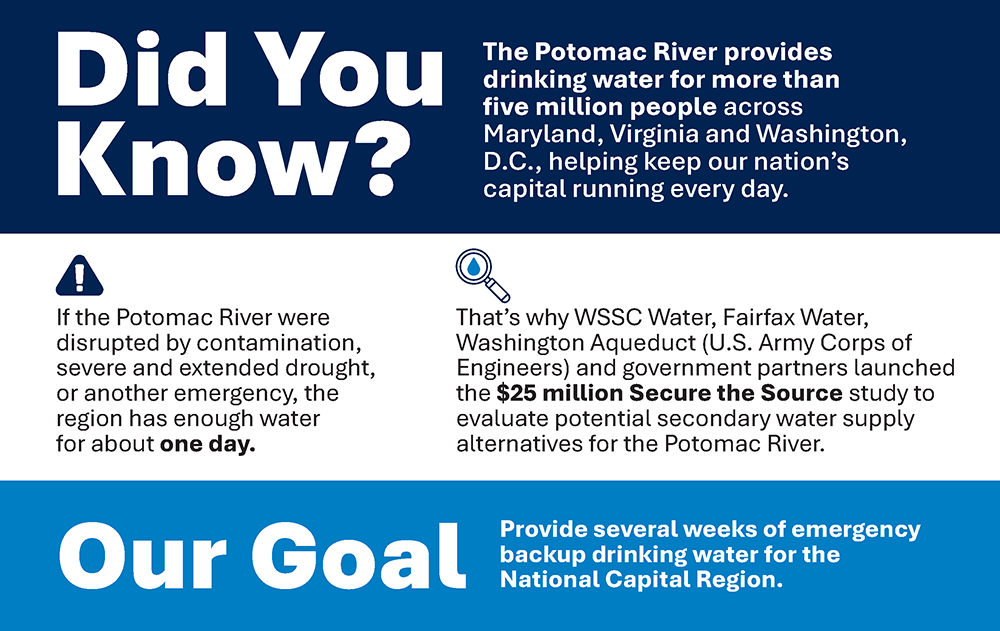
WSSC Water, in partnership with Fairfax Water, Washington Aqueduct (U.S. Army Corps of Engineers) and government partners, recently launched the $25 million Secure the Source study, a historic two-year initiative to strengthen the water supply for the National Capital Region. The study will evaluate large-scale backup solutions to provide several weeks of emergency drinking water for over five million residents, businesses, federal agencies and military installations in Maryland, Virginia and Washington, D.C., who depend on the Potomac River.
Why Now?
The Potomac River is the single primary source of drinking water for the region – heavy reliance on one source without an adequate emergency backup water supply poses inherent risks.
Recent approval by the Assistant Secretary of the Army - Civil Works enables non-federal parties and regional leaders to begin this landmark effort.
Growing threats: contamination, deliberate attack, prolonged drought and projected increased risks of water supply shortages, aging upstream infrastructure, infrastructure failure, natural disasters, increases in water demand and climate variability require renewed commitment to large-scale solutions.
Goals
Provide several weeks of backup drinking water storage for over five million people.
Two-year study will evaluate numerous alternatives and then proceed with a 35 percent design with associated environmental and geotechnical investigations, to develop a solution that benefits the entire region.
Engage a diverse group of regional stakeholders and the public to ensure successful study completion, support for the project and for future investment in construction phases.
Potential Alternatives Being Evaluated
No action
Travilah Quarry (MD)
Blue Plains Advanced Water Reuse (D.C.)
Luck Stone Quarries B & C (VA)
Regional Collaboration & Leadership
Joint effort among WSSC Water, Fairfax Water, Washington Aqueduct (U.S. Army Corps of Engineers) and government agencies.
Builds on decades of regional cooperation and investments (e.g., Jennings Randolph Reservoir, Little Seneca Reservoir).
Study will help identify a large-scale solution that strengthens the region’s resilience.
Economic & Public Health Impact
If the Potomac River water supply is disrupted for more than a day, it will lead to a water crisis that is a regional public health and national security emergency.
A one-month disruption could result in up to $15 billion in lost gross regional product and hundreds of millions in tax loss.
Reliable drinking water for the entire Washington D.C. metro area is essential for public health, fire protection, economic vitality, national security and continuity of government operations.
Next Steps
The first phase of the study is expected to be completed in 2028, with the next phase completed in 2030; positioning the region to pursue federal, state and local investments for construction of the recommended solution.
Region will need unified support to identify and secure funding and implement long-term water security infrastructure construction.
Questions and More Information
Please contact Katie Foreman, [email protected], with any questions regarding Secure the Source.