Industrial Discharge Control Program
WSSC Water's Industrial Discharge Control Program is an industrial pretreatment program that regulates industrial and commercial discharges to the sanitary sewer system.
WSSC Water's Industrial Discharge Control Program is an industrial pretreatment program that regulates industrial and commercial discharges to the sanitary sewer system.
WSSC Water has been regulating non-domestic wastewater discharges to its sanitary sewer system since 1925. Now known as the Industrial Discharge Control (IDC) program, this pretreatment program was approved by the U.S. Environmental Protection Agency (EPA) in 1983 and has since been recognized nationally by EPA as an "Outstanding Pretreatment Program."
The objectives of the IDC program are to:
The program meets its objectives by evaluating IUs for compliance with the WSSC Plumbing and Fuel Gas Code; issuing permits for Significant Industrial Users (SIUs), conducting wastewater monitoring and comprehensive facility inspections and issuing permits to waste haulers operating within WSSC Water’s jurisdiction. Learn more about WSSC Water's Waste Hauler Program.
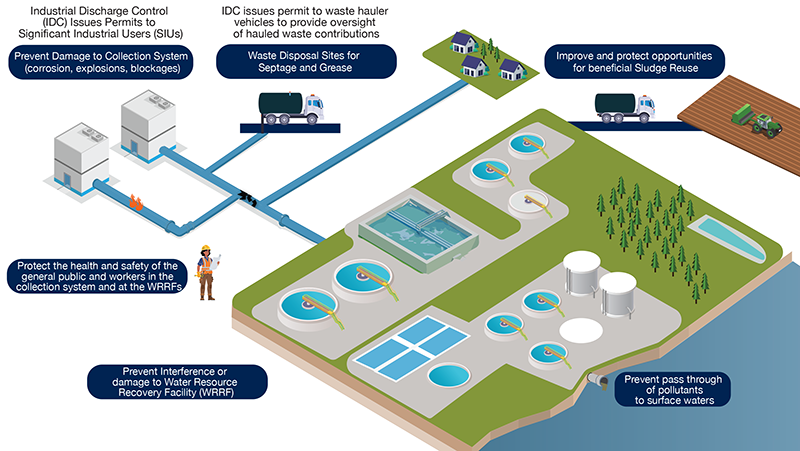
An IU is defined as any place of business, endeavor, arts, trade or commerce, whether public or private, commercial or charitable, that uses water in a product, process, or any manner that generates wastewater, which is a source of indirect discharge. All IUs located within WSSC Water's jurisdiction must comply with Section 8 of the WSSC Plumbing and Fuel Gas Code, Industrial Waste Regulations.
WSSC Water routinely evaluates IUs to determine compliance with the WSSC Plumbing and Fuel Gas Code and whether a WSSC Water Discharge Authorization Permit (DAP) is required. This review helps ensure that industrial discharges do not harm the sanitary sewer system or its workers, interfere with treatment processes or impact water quality. New and existing businesses that are uncertain of their status may submit an Industrial Wastewater Survey, which WSSC Water reviews to determine regulatory applicability and Code compliance.
Through its pretreatment program, WSSC Water regulates a range of IUs. Permitted users may include SIUs, certain zero dischargers and temporary dischargers of metered wastewater. All SIUs are required to submit a DAP application to obtain a DAP, which are issued for a four-year term.
WSSC Water has compiled the following permitting guidelines and resources to assist businesses operating within its jurisdiction:
IU permit fees for Fiscal Year (FY) 2027 (July 1, 2026 – June 30, 2027) are as follows:
| Permit Type | Permit Length | Fee |
|---|---|---|
| SIU Initial Permit | 4 years | $11,785 |
| SIU Renewal | 4 years | $5,780 |
| Zero-Discharge Initial CIU Permit | 4 years | $4,470 |
| Zero-Discharge Renewal CIU Permit | 4 years | $2,980 |
| Temporary Discharge Permit (non-SIU) | Project length | $11,785 |
SIUs with active DAPs will share part of the cost of WSSC Water's administration of the IU pretreatment program. Annual program fees are based on the volume and characteristics of the non-domestic wastewater discharged, as well as the level of oversight required to ensure compliance with WSSC Water and federal standards.
Property owners with tenants that discharge non-domestic wastewater to the WSSC Water sanitary sewer system may find an annual program fee on their bill. Upon written request from the property owner, WSSC Water can provide a breakdown of tenant names and associated fees.
The FY2027 IDC annual program fees are as follows:
| Category | Description | Annual Fee |
|---|---|---|
| 1A. | IUs subject to Categorical Pretreatment Standards (less than 5,000 gallons per day) | $9,910 |
| 1B. | IUs subject to Categorical Pretreatment Standards (greater than 5,000 gallons per day) | $15,180 |
| 1C. | Non-Discharging Categorical Industries | $2,675 |
| 2A. | SIU less than 25,000 gallons per day | $9,910 |
| 2B. | SIU greater than 25,000 gallons per day | $15,180 |
| N/A | Late Payment Charge | 5% of fee |
The IDC program regulates approximately 40 SIUs, which are inspected and monitored at least annually to verify compliance with federal and local discharge limitations.
Violations of applicable discharge limits or permit conditions may result in enforcement actions, consistent with the program's Enforcement Response Plan (PDF 636 KB).
In accordance with Title 40, Part 403.8 of the Code of Federal Regulations (CFR): Pretreatment Program Requirements: Development and Implementation by [Publicly Owned Treatment Works], WSSC Water administers the IDC program to regulate the discharge of pollutants to the sanitary sewer system in Montgomery and Prince George's counties. The following IUs were found to be in Significant Noncompliance (SNC), as defined in 40 CFR 403.8(f)(2)(viii), with EPA's National Pretreatment Standards and/or applicable local limits:
| SIU | SNC During the 2025 Evaluation Period (October 2024 Through December 2025) |
|---|---|
| Cintas Corporation (1769 Brightseat Road, Landover, MD 20785) | Failed to notify WSSC Water within 24 hours of becoming aware of a violation. This violation constitutes SNC for failure to accurately report non-compliance during the October 2024 through March 2025 evaluation period. Enforcement actions included a Notice of Violation (NOV), a civil citation, and a compliance directive. |
| Joint Base Andrews-Naval Air Facility, Washington (316 CES/CEIE 3466 North Carolina Avenue, Joint Base Andrews, MD 20762) | Violated the permitted daily maximum limitation for Total Phosphorous on October 8, 2024, October 29, 2024, November 19, 2024, and February 6, 2025. This violation constitutes Technical Review Criteria, SNC during the October 2024 through March 2025 evaluation period. Enforcement actions included NOVs, additional monitoring, and a compliance directive. The industry has returned to compliance for Total Phosphorous. |